

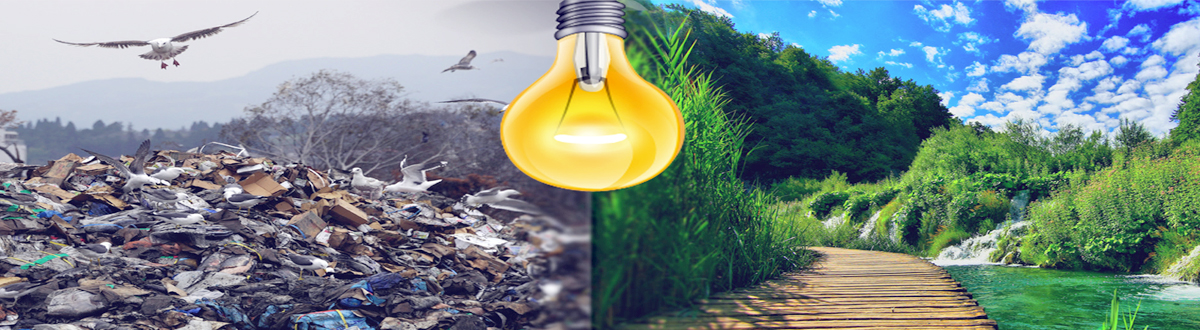
Waste to Energy Project Electricity Generation of 231,121,000 kWh / YEAR
The summary addresses the waste conversion Combi-tech Technology, which utilizes Mixed Municipal Solid Waste in order to generate Electricity and produce Cooling Energy (Waste Heat) and Fertilizer as by-products. Therefore, this Technology not only generates a useful output but also utilizes Municipal Solid Waste, which has become a national concern in the Indian context.
This Technology has the capacity of utilizing approx. 600 Tons of Garbage in order to produce approx. 700 Mwh (28 Mw) of electricity per day. We will be accepting the landfilled waste as well, which will add up to a total of 25% of the total waste utilization, where we are willing to accept this garbage even without a Tipping Fee.
Comparing the Combi-tech process with Incineration, the efficiency is calculated at approx. 80%. From the 80% output, 42% will be in form of Electricity and 58% will be in the form of Heat. Whereas, Incinerator Plants usually reach only up to 50 – 60% efficiency, with the same ratio between Electricity and Heat as above.
Considering the funding aspect of the Project, 72.5% of the total funding will be provided through GES (German Environment Solution GmbH). 5% of the total equity will be offered to a Local Government Organization, who will be directly involved in this Project via a PPPA (Private Public Partnership Agreement). 27.5% of the total equity will be offered to a State Registered Lending Organization, which will provide the balance 27.5% of the total investment.
The Return on Investment (ROI) of the Project, calculated considering only Garbage as input and Electricity as output comes up to approximately 8.5 Years, whereas the ROI calculated considering the revenue generated from all the outputs, including by-products is approx. 3.8 Years. Amortization period for Renewable Energy Projects on a global standard is 15 Years, which also showcases the feasibility and viability of our Technology.
Benefits that the State can obtain in addition to the Generation of Electricity is the purchase of Fertilizer that is produced as a by-product of the process, which will have a drastic impact on the reduction of Fertilizer that is being imported for agricultural purposes. Since this is a Fertilizer that is an output of a biological process, it will invariably help yield a better harvest.
The total quantity of Fertilizer that can be produced using the total garbage quantity per annum is approx. is 40,000 tons. This Fertilizer can be used for any crop and it contains exactly the minerals, which the plants absorb from the soil during their growth. This compost contains cellulose particles as well, which loosen the soil and hold the water aerating the soil.
Additionally, the heat generated through the process can also be utilized through Cold Rooms, where it will help reduce the post-harvest losses. This will directly result on the agricultural harvest, such as seasonal fruits and vegetable, being stored in these Cold Rooms, where it can be utilized throughout the year. The same Technology is being used in Netherlands and China at present.
Another advantage of this process is that there will be no odour or environmental hazards compared to Landfill and Incineration, which proves this to be a state-of-the-art Technology that will be most suitable for GCC Countries.
The enclosed BUDGETARY PROPOSAL (prepared in the Sri Lanka context) is intended as preliminary information.
A Customized Proposal can be arranged with the availability of the following data:
1) What is the present power tariff that the Government is paying for 1 Unit of
Renewable Energy?
2) What is the Tipping Fee for the Garbage?
3) What is the collection method of the garbage at the moment?
4) What is the total collection of the garbage per day in Tons?
SUMMARY
The Concept:
The Proposed Waste Treatment Plant consists of two parts, the first part for treating the organic fraction by anaerobic digestion (BioTech) and the second part for treating all the “soft” residues such as the plastics, the celullose/lignin fraction and possibly the non-digestible compost substrate fraction from the digestion plant, which are not accessible to the biological attack of bacteria by a new and specific liquefaction and gasification process (SRS). In this way a maximum energy efficiency is obtained and the entire waste is treated/converted except for the mineral fraction (stones, sand, broken glass, batteries) which does not exceed 10% of the input quantity.
Advantages:
The biological and chemical processes take place in closed tanks, so that no environmental affects like smell or ground water contamination will occur, i.e. CombiTech plants can be installed close to populated neighbourhoods.
The CombiTech process may treat without modifications such a wide variety of refuse:
– Mixed, unsorted household waste in various compositions- Industrial waste (organic, plastics, wood, textiles and paper, from food and manufacturing
– Waste from existing landfills
– Agricultural wastes, such as remains from olive pressing
– Agricultural animal waste and manure
– Waste from the gastronomic industry
– Slaughter houses waste
– Sludge from settling tanks and wastewater treatment plants
– Garden trimmings
Project Cost and Funding:
The Total Project Cost will be approx. 136 Million Euros.
Considering the funding aspect of the Project, 72.5% of the total funding will be provided through GES (German Environment Solution GmbH). 5% of the total equity will be offered to a Local Government Organization, who will be directly involved in this Project via a PPPA (Private Public Partnership Agreement). 27.5% of the total equity will be offered to a State Registered Lending Organization, which will provide the balance 27.5% of the total investment.
The Return on Investment (ROI) of the Project, calculated considering only Garbage as input and Electricity as output comes up to approximately 8.5 Years, whereas the ROI calculated considering the revenue generated from all the outputs, including by-products is approx. 3.8 Years. Amortization period for Renewable Energy Projects on a global standard is 15 Years, which also showcases the feasibility and viability of our Technology.
REFERENCE LIST OF PLANTS (Partial)
The BioTech technology has been developed in the years 1993 – 1995 with assistance from the German Ministry of Research and Development. Plants available in the following areas will prove to be successful implementations of the same.
- City and District of Schwabach, Germany
- District of Westerwald, Village of Boden, Germany
- Alteno/Duben near Cottbus, Germany
- City of Avila, Spain
- City of León, Spain
- City and district of Stade, Germany
- City of Jever (Wiefels)
- City of Lana (MeraLin), Italy
- City of Deerdykes, UK (Scotland)
- BiogasplantKarstaedt, Germany
- City of Pamukova, Turkey
There are 20+ Running Plants, around the world.
REFERENCE LIST OF FEW PLANTS
The BioTech technology has been developed in the years 1993 – 1995 with assistance from the German Ministry of Research and Development. Plants available in the following areas will prove to be successful implementations of the same.
- City and District of Schwabach, Germany
- District of Westerwald, Village of Boden, Germany
- Alteno/Duben near Cottbus, Germany
- City of Avila, Spain
- City of León, Spain
- City and district of Stade, Germany
- City of Jever (Wiefels)
- City of Lana (MeraLin), Italy
- City of Deerdykes, UK (Scotland)
- BiogasplantKarstaedt, Germany
- City of Pamukova, Turkey
There are 20+ Running Plants, around the world.